
Phase1: The Library of control
the phases
The Office of Control is releasing work in phases, beginning with Phase 1: Models of coercion, the bedrock of the project, on top of which we’ll build out the more speculative layers of work.
the library
The Office of Control has compiled a library of over one hundred models — social, political, and economic mechanisms that enable coercion by exploiting human psychology.
They are not theoretical. Every mechanism documented here exists, has historical precedent, and is deployed now. In marketing. In technology. In immigration enforcement, welfare administration, criminal justice, population management.
Some carry the names of their original researchers — Milgram or Stenner. Others have been identified and named by The Office of Control itself, drawn from patterns that recur across history without ever having been formally catalogued.
The models are blueprints of our weaknesses - the distillate of our souls’ vulnerabilities - that have been templated, productised, and set to work against us.
We are pre-wired for coercion. The models do not fight human psychology. They follow it.
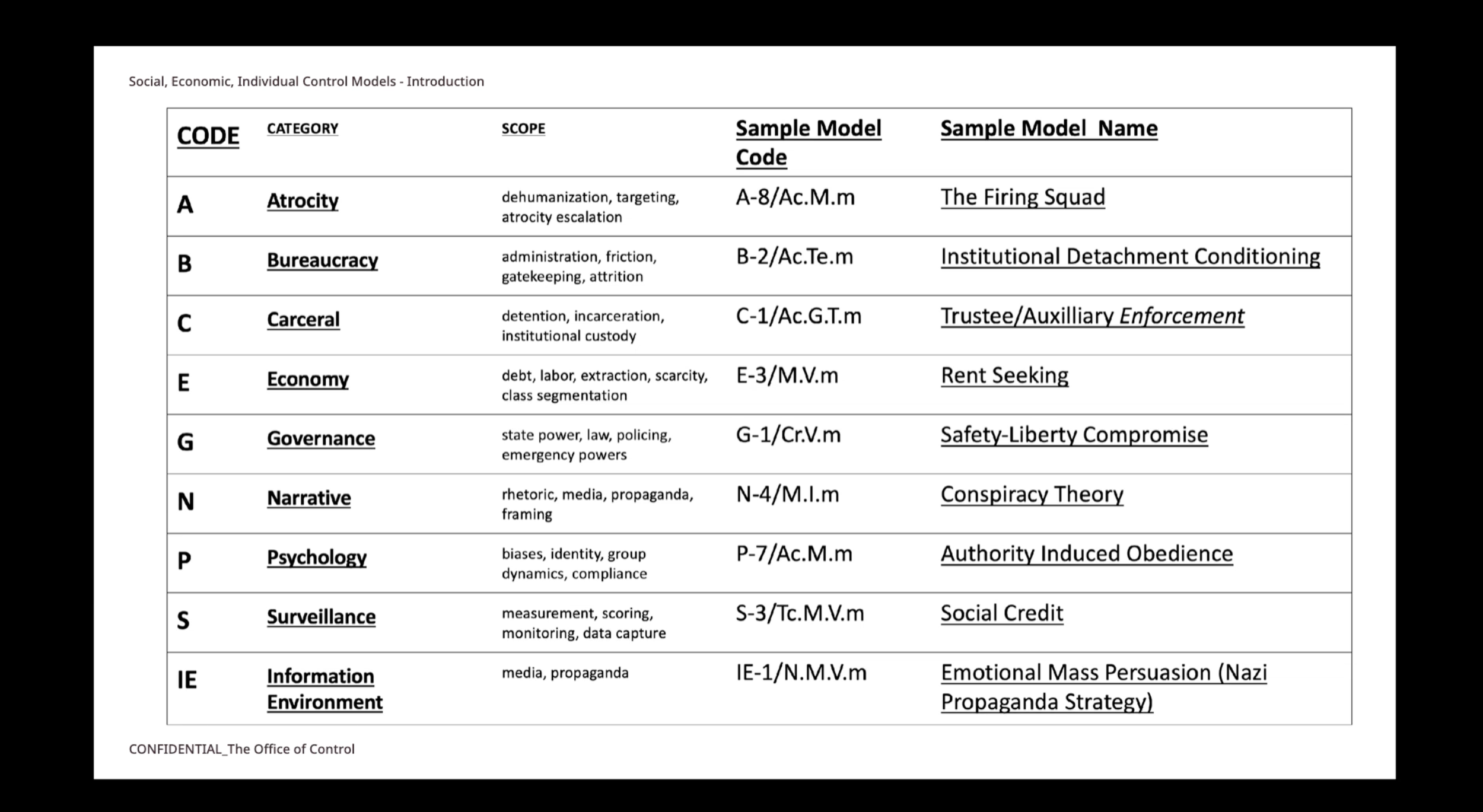
Model Classification from OOC_M2_Office of Control Models Introduction
Still from Video.
born of fire
Many of these models emerged from attempts to understand the darkest episodes of the twentieth century. Milgram's obedience experiments — in which subjects administered what they believed were severe electric shocks to unseen victims, on the instruction of an authority figure — were themselves a response to a question the post-war world could not answer by moral reasoning alone: how did ordinary people carry out atrocities while claiming they were just following orders?
Psychologists wanted to know what made those orders so easy to follow.
The answer was not comfortable. The orders were easy to follow because the architecture of obedience is natural. It exploits deference, diffusion of responsibility, distance from consequence, and the bureaucratic separation of action from outcome. It does not require monsters. It requires structure, productising, repetition, and training.
The mechanisms are not imposed from outside human nature. They emerge from within it. That is the danger. Because they are built upon our own psychologies, they are simple for humans to enact — often without recognising they are doing so.
in our world
The examples from our current age of populism are not hard to find. They are the coarse texture of modern political life.
Politicians deploy Enemy Image Construction (A-2/Cr.T.DH.m) as their primary strategy — Muslim travel bans, migrant caravans, welfare claimants as scroungers — divisive signalling that consolidates ingroup loyalty by making the outgroup a threat.
Populist leaders invoke National Mythic Moments (N-2/Cr.M.Te.m): Make America Great Again, Battle of Britain nostalgia, imperial mythologies. These reach back to imagined ages that, on examination, included internment, civil liberties erosion, and the rights suppression of the very people being asked to feel nostalgic.
Contemporary far-right propaganda targets young men with precision, exploiting neurological predispositions toward risk-taking and susceptibility to violent messaging. Conspiracy Theories (N-4/M.I.m) — QAnon, Pizzagate, their successors — emerge in communities of disenfranchisement, directing alienation toward hidden elites and deepening the bifurcation that produced the alienation in the first place.
These are not accidents. They are applications.
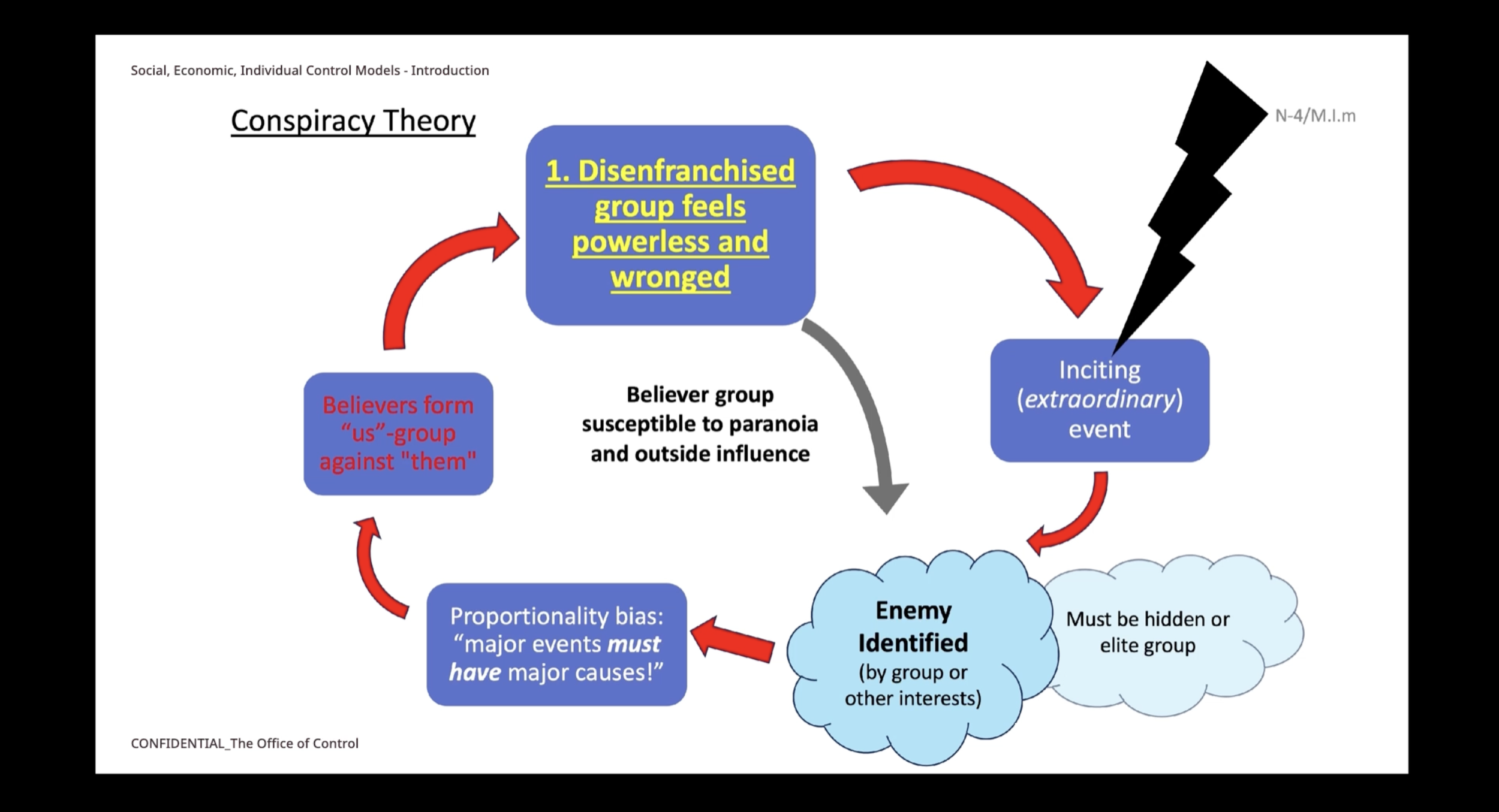
Conspiracy Theories (N-4/M.I.m)
from OOC_M2_Office of Control Models Introduction
Still from Video.
the models
Authoritarian Consolidation Schema (G-1.B.N.IE.s)
The most structurally complex work in Phase 1 is not a single model but a schema — a collection charting the four phases through which authoritarian power establishes itself: Conditions, Activation, Enabling, Capture.
The schema shows the threshold moment. When Normative Threat — the perceived pressure on the existing social order — crosses into Activation, the coercive mechanisms mobilise. The engine of the Enabling phase is the Narrative Reinforcement Cycle: a loop between National Mythic Moment (N-2/Cr.M.Te.m), Conspiracy Theory (N-4/M.I.m), Emotional Mass Persuasion (IE-2/N.M.V.m), and Disinformation Laundering (IE-3/G.N.V.I.m), each amplifying the others. The system closes with quiescent lock-in — compliance achieved not through continued coercion but through normalisation. The authoritarian terms become the only available terms.
The schema has precedent. It describes behaviours observable in leaders with authoritarian ambitions today, across multiple national contexts, simultaneously.
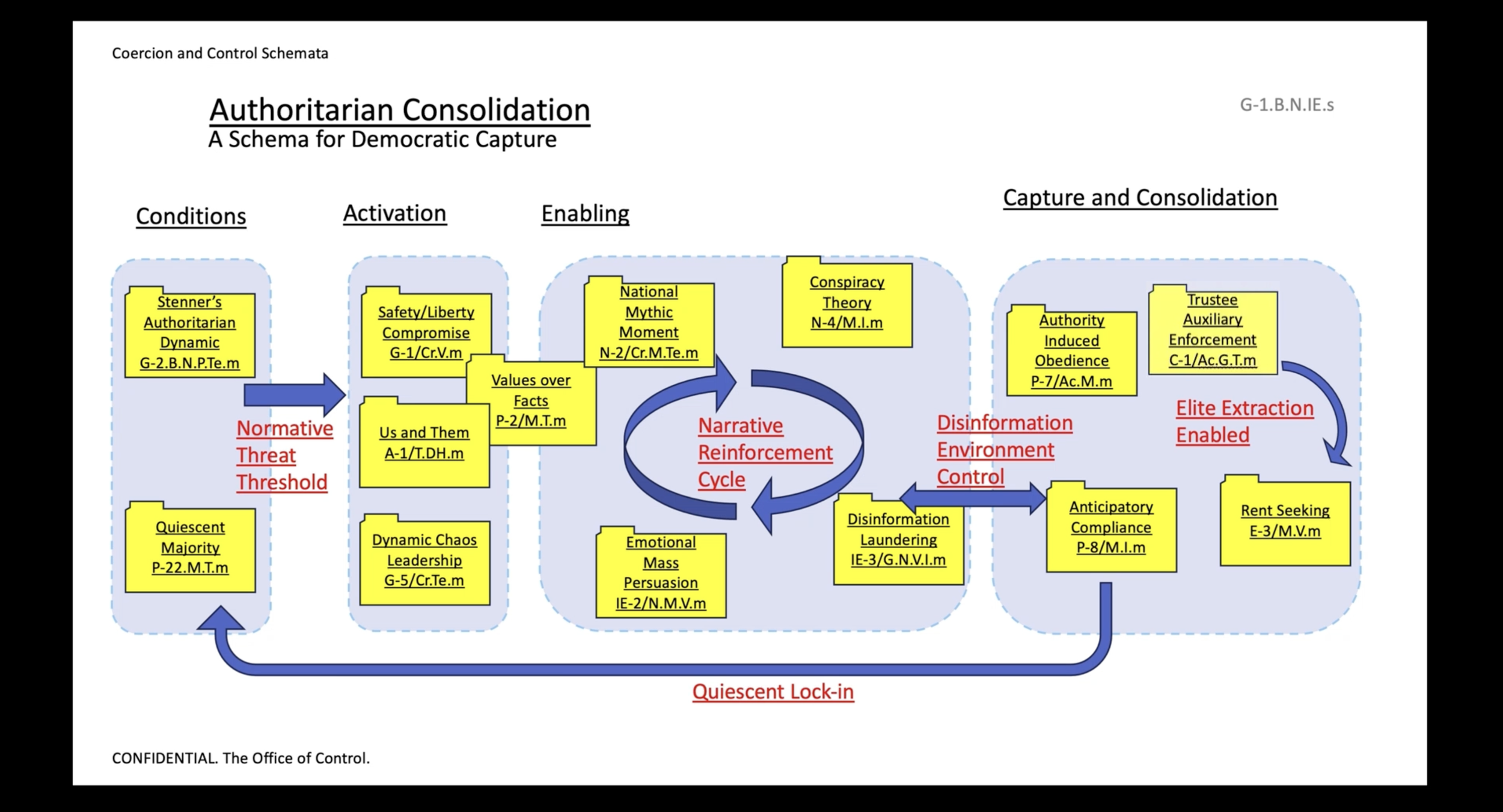
Authoritarian Consolidation Schema (G-1.B.N.IE.s)
Still from Video.
Social and Political Coercion Models — Training Intro
A selection of models from the library appears in the Training Slideshow: a presentation assembled in PowerPoint, running through models in sequence.
The format is deliberate. PowerPoint is the timeless modern medium for bureaucratic knowledge transfer — the software of training days, compliance briefings, onboarding. This is how organisations transmit their operating norms, their values, their expectations of behaviour.
It is in this everyday banality The Office of Control manifests.
Are they the clearest diagrams they could be? No. They are made by average humans, not trained designers. The lethal signal of the models' intent is clouded by default fonts and distracting animation. This is our shared global corporate and institutional voice of the last few decades. But the models are readable and honest and everyday, hidden, walking among us.
Orientation: Administrative Assistant Role
The Orientation video addresses an example administrative assistant role and includes the institutional values of The Office of Control.
The values repay close attention. They are very close to most corporate values people may have experienced, but they have darker roots.
The first, ask up, invokes Authority Induced Obedience (P-7/Ac.M.m) — the mechanism derived from Milgram, in which individuals defer upward, dissolving personal moral agency into institutional hierarchy. The second, we're in this together, is peer-induced compliance: the firing squad principle, in which shared participation distributes and therefore neutralises individual responsibility. The third, trust the process, performs the same dissolution at a larger scale — responsibility devolved not to a peer group but to the bureaucracy itself. No individual needs to answer for what the system does.
These are not incidental phrasings. They are the models made rhetorical. The values of The Office of Control demonstrate, in the language of institutional mission statements, exactly how coercive mechanisms embed themselves in the most banal registers of organisational life.
Disinformation Laundering (IE-3/G.N.V.I.m) and Disgust Based Dehumanisation (A-3/DH.m) Breakdowns
Breakdown models tell the story simply. Disinformation Laundering (IE-3/G.N.V.I.m) (credit to Anne Applebaum's phrase ‘information laundering’ in Autocracy Inc.) is a phased account of how false or misleading information is processed through institutional, media, and social systems until it acquires the appearance of legitimacy.
Like the basic Disgust Based Dehumanisation (A-3/DH.m) model presented alongside it, the breakdown format runs through the mechanism's phases, its historical precedents, and — crucially — the conditions under which it can be disrupted.
To name a mechanism is to begin to interrupt it.
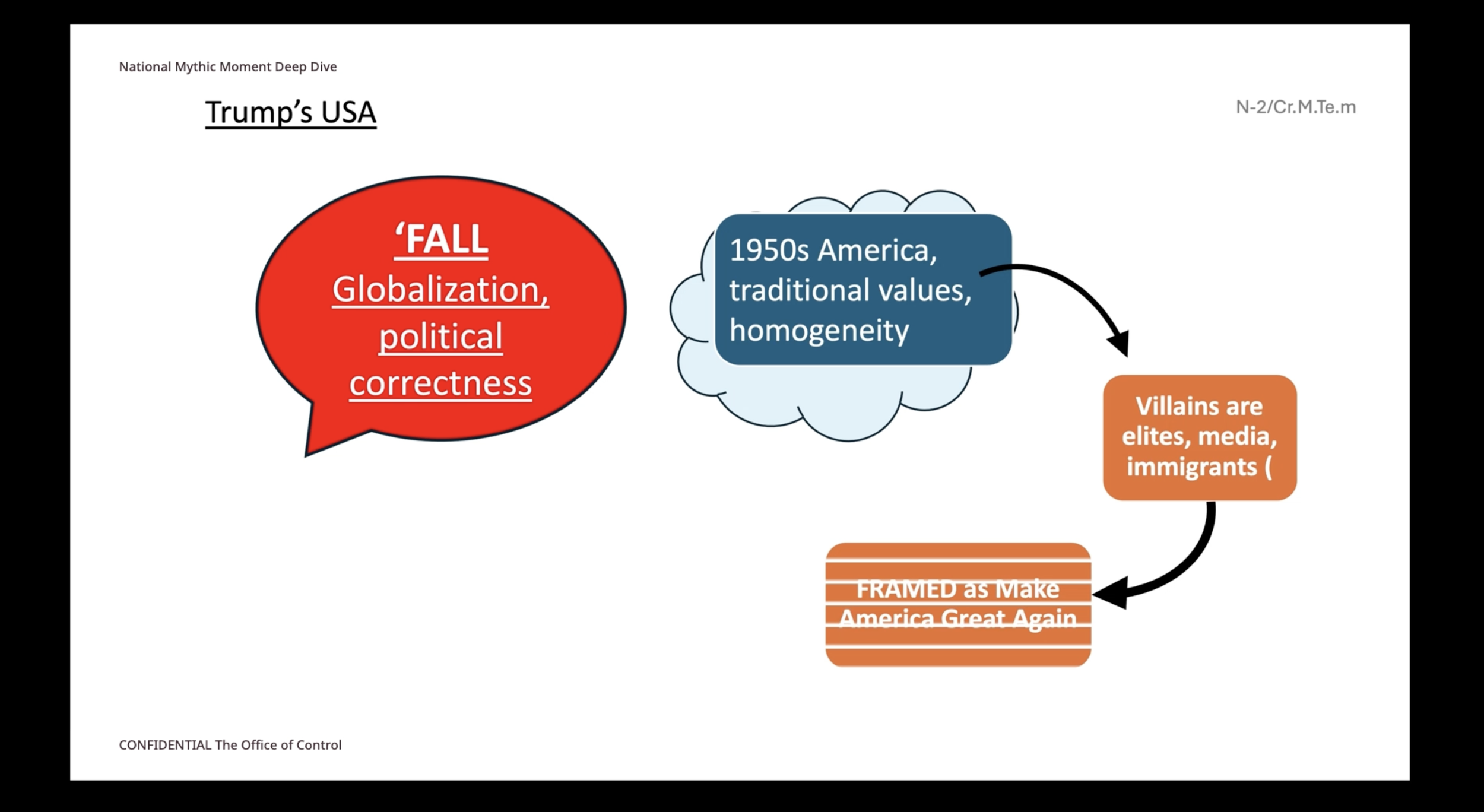
OOC_M6_National Mythic Moment (N-2/Cr.M.Te.m) Deep Dive
Still from Video.
National Mythic Moment (N-2/Cr.M.Te.m) — Deep Dive
National Mythic Moment (N-2/Cr.M.Te.m) receives the most extended treatment in Phase 1. The depth of that treatment is itself part of the argument. The duration here hints at the horror of the content. It is long, and though not disinteresting, demands the viewer stays involved, stays mindful of difficult material.
The model describes the process by which a selective, emotionally charged version of national history is constructed and deployed — to produce loyalty, justify policy, suppress dissent. It is not about historical events. It is about the work those events are made to do in the present. Nostalgia is productive, generative. It is a narrative tool.
The UK's relationship to the Second World War. Russia's to Imperial and Soviet times past. The United States' to the 1950’s. Each involves the construction of a National Mythic Moment (N-2/Cr.M.Te.m) that operates not as history but as alternative instruction: this is who we are, this is what we will defend, this is who threatens us.
the medium
Across all six works in Phase 1, the production choices are consistent and deliberate. The voice is institutional — measured, professional, administrative. These are the forms in which real organisations transmit real expectations to real people.
But listen carefully.
A keypad press. A slight glitch. A cut. The sound design carries traces of production — not of a seamless institutional machine, but of people at desks, making things, staying late, making last minute amends. The Office of Control sounds like any other organisation.
This is not a parody. The Office of Control is not satirising bureaucracy from a comfortable ironic distance. It is demonstrating how bureaucracy works — including how bureaucracy looks and sounds, how it is made, and by whom. It is how bureaucracy sounds while it works, while it operates, its aural exhaust.
The people who transmit these models are not exceptional. They are not sinister geniuses. They are people who understand human psychology enough, or who work for those that do, who have access to research, and who apply what they know within institutional structures that permit and reward the application, according to their objectives or incentives. They are, in the language of the orientation, just doing their jobs.
The glitches ask of us: who are these people? What is this office? Does it exist? And when?
Those questions will be addressed in the phases that follow.
the beginning
Phase 1 presents a selection of models. The library currently holds over one hundred models, continuously updated as new mechanisms are identified or historical patterns clarified. The full database will not be released, just as we cannot see all the magma at the Earth's core, rather its effects and eruptions.
This is not coyness. The gathering of these models and making them accessible raises genuine ethical questions. These frameworks — for othering, for population control, for compliance induction — must not be concentrated and distributed in forms that serve the interests they describe. The Office of Control will not realise the whole set of models. It will not provide a toolkit to those who would use it as one.
What is shown here is a glimpse.
Enough to recognise the shape of the library, to understand the scope and seriousness of the project, and to begin to see the mechanisms in the world around you.
The models are clues to a wisdom both ancient and modern — developed by a few, innate in everyone, and an existential risk to us all.
The naming of a thing is the beginning of power over it.
Look for National Mythic Moment (N-2/Cr.M.Te.m) the next time a politician invokes national greatness. Look for Disinformation Laundering (IE-3/G.N.V.I.m) the next time a false claim migrates from fringe forum to broadcast news. Look for Authority Induced Obedience (P-7/Ac.M.m) in the next organisational values statement you read.
The models are everywhere, once you can see them.