
Concepts of control
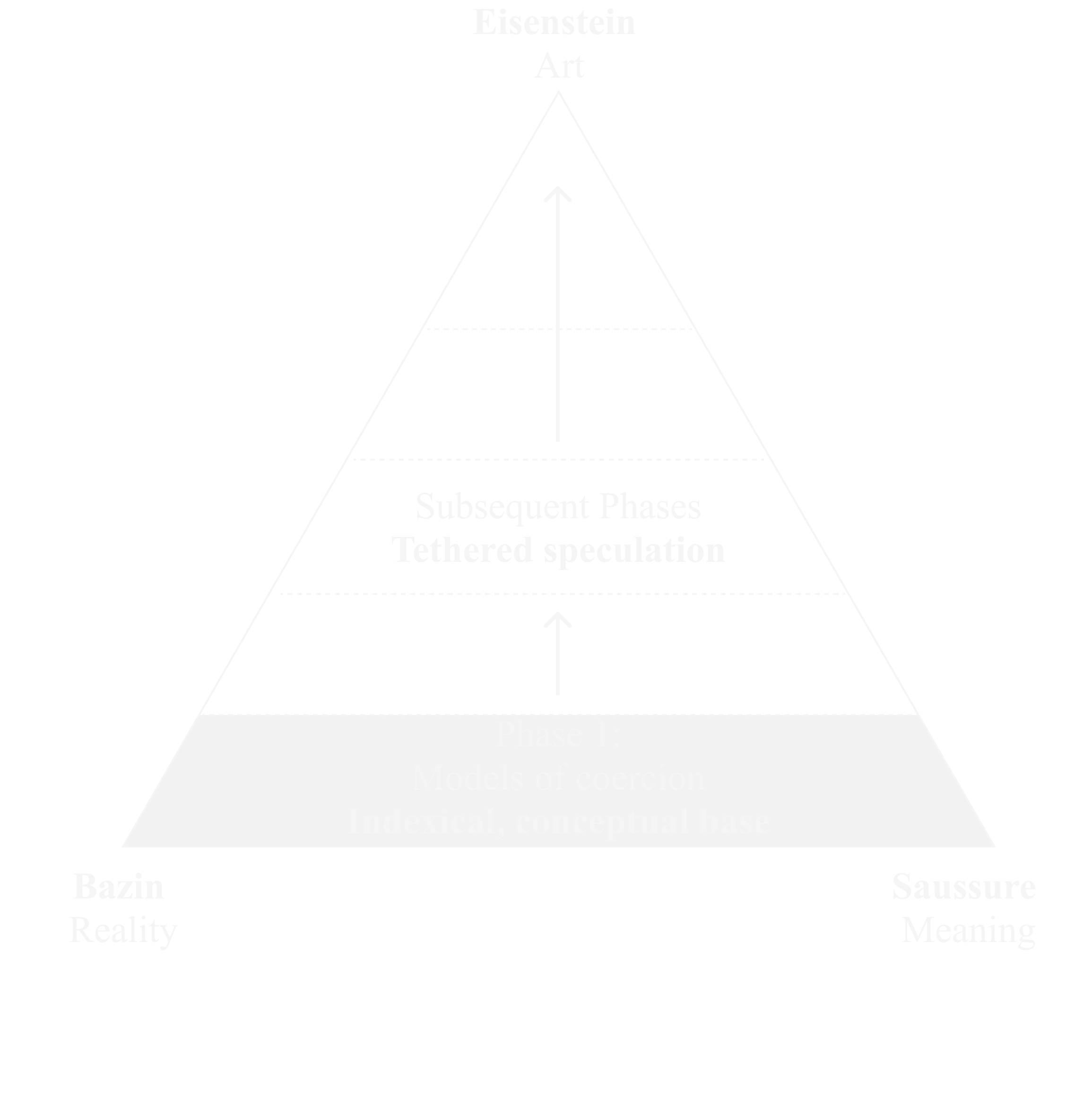
The Office of Control explores Speculative Bureaucracy: the materials and processes enabling authoritarian systems. The work will be released in phases, starting with training videos of coercion models, moving to speculative projects that put these into imagined practice and place.
Phase one’s Models are based on real mechanisms of political, societal and institutional coercion. Subsequent phases will introduce speculative artefacts in which those mechanisms can be examined in a related remove from the political and psychological moments that produced them.
These phases are based on a conceptual framework inspired by three thinkers.
André Bazin (18 April 1918 – 11 November 1958) wrote the importance of unabridged reality.
Ferdinand de Saussure (November 26, 1857, to February 22, 1913) wrote about language and essential meaning in concepts.
Sergei Eisenstein (23 January 1898 – 11 February 1948) wrote about the mediated image.
None of them were explicitly writing about bureaucracy or political coercion, but their work has provided a basis for The Office of Control to describe exactly how institutional power works: how we ground our approach in reality, how we construct a language that feels natural, and how we can speculate on imagined futures.
This essay explains how those three ideas underpin the whole project, and the critical areas of political art and institutional critique into which The Office of Control practice and work sits.
Reality: Bazin and the Indexical
André Bazin argued that photography liberates image-making from the deceit and mediated compromise of painting. To Bazin, a painting is an interpretation. A photograph is a record made of light and film. This gives the photographic image a claim on reality that artist-created representations don't have.
He argued that the artist cannot help but include themselves in the painting and that they implicitly embellish the truth of the subject with their own ideas, diminishing any claims of painting to the higher quality of realism – that only photography can deliver.
“The personality of the photographer enters into the proceedings only in his selection of the object to be photographed and by way of the purpose he has in mind.”
André Bazin, What is Cinema? Vol. 1, essay "The Ontology of the Photographic Image" (1945), trans. Hugh Gray, University of California Press, 1967.
Bazin called this reality the indexical quality of the image. Indexicality is the direct, unmediated connection between image and source. The image points back to something that is actually there.
The German filmmaker Harun Farocki (9 January 1944 – 30 July 2014) extended Bazin’s logic into institutional life.
He identified a category he called the operational image—an image made not to be looked at, but to perform a function within a system. Surveillance footage, targeting data, factory monitoring feeds: none of these are made for an audience. They are made primarily to do work. Farocki's insight was that these images carry the indexical weight Bazin described, but in service of administration rather than representation.
"These are images that do not represent an object, but rather are part of an operation."
Farocki, H. (2004). Phantom Images. Public, (29). Retrieved from https://public.journals.yorku.ca/index.php/public/article/view/30354
The coercion models in The Office of Control occupy a similar position to coherent working documents. They are presented as working documents as much as artworks. That functional quality is the source of their authority.
Trevor Paglen (born 1974) approaches the indexical institution from the outside-in. Where Farocki examined the images that institutions produce for their own use, Paglen photographs what institutions actively work to keep invisible—classified facilities, signals infrastructure, the physical geography of surveillance.
“What I'm trying to do is to get a glimpse into the secret state that surrounds us all the time but that we have not trained ourselves to see very well.”
Source: Trevor Paglen, interview with The Independent, Monday 16 June 2014
His images are difficult to make and difficult to read, but their political force comes precisely from their documentary claim: this exists, it is here, hidden, but the camera found it.
The Office of Control draws indexicality into its coercion models. Some that we reference are real such as Stenner’s Authoritarian Dynamic, G-2.B.N.P.Te.m, whereas others are composites of established ideas - such as Enemy Image Construction A-2/Cr.T.DH.m.
The models are all drawn from real political and social science research—studies of how institutions manage populations, how compliance is engineered, how dissent is neutralised.
The bureaucratic visual language of the models in the videos – the default corporate-administrative fonts, the animation-naif and PowerPoint-folk-design – is real. The visual forms, procedures and narrative structures all exist in the world. They operate in plain sight, inside ordinary management practice. The voice-overs are played straight, the voices are devoid of drama, demographically neutral, dampened by the mid-level banality of administration.
The models are a visual, aural and conceptual Ground-Zero - built on evidence not speculation. They show what is in our world and our history. This is not a fictional dystopia, it is an analysis of how societies are managed.
Meaning: Saussure and the Sign
Ferdinand de Saussure argued that the relationship between a word and what it means is assigned by convention, agreed upon, maintained through use, and eventually so naturalised that it feels inevitable.
This matters because institutional language works the same way. If anything, institutions are meaning manufacturers and magnifiers, specializing in developing words and concepts that suit their goals, crafting and perfecting them with their captive recipients and users.
Hans Haacke (born August 12, 1936) spent fifty years demonstrating exactly this. His method was simple: take the sign systems institutions use to represent themselves—annual reports, property records, donor lists, mission statements—and present them without comment in an art context. The institutional language, removed from its functional setting, becomes available for reflection.
The Office of Control treats institutional language as a sign system to be examined. Each model is built from the vocabulary of institutional management.
Mark Lombardi's network diagrams make the same argument visually. Working through the 1990s, he mapped the actual connections between institutions—banks, governments, intelligence agencies, arms dealers—in large hand-drawn fields sourced entirely from public records, congressional testimony, and financial filings. Every connecting line had a citation. By rendering the network in a single drawn field, Lombardi showed how power organises itself as a system of relationships rather than a hierarchy of commands. The diagram reveals what the official language conceals.
“Lombardi has created a new type of history painting that maps late twentieth-century corruption in abstract terms."
Robert Hobbs, Mark Lombardi: Global Networks, ICI, 2003.
By presenting the vocabulary of coercion in a controlled documentary format, the models in The Office of Control make that vocabulary visible as a construction and concept, as important as colour or texture to a painter.
The Office of Control is building literacy in the critique of institutional language to increase public access, and eventually, to implicate us all through our understanding.
Art: Eisenstein and the Speculative
Sergei Eisenstein argued that meaning in film is not carried by individual images but by the collision between them. Put two images together and you produce a third idea that neither image contains on its own. He called this montage. It was his theory of construction—of how an argument gets made through alchemic juxtaposition rather than rote continuity.
Once the Office of Control has established its grounding in real evidence and begun to decode the sign systems of institutional language, it earns the right to start constructing new ideas and realities.
The future-phased speculative artefacts in The Office of Control—the project's plans and administrative ephemera —will be montage operations. They will take fragments of real institutional practice and assemble them into something that does not quite exist but is entirely plausible. The result is not documentary and not fiction. It is something that sits between them and is more politically useful than either.
A close precedent is the work of Walid Raad and his fictional research foundation The Atlas Group. Between 1989 and 2004, Raad fabricated an institutional archive purporting to document the Lebanese civil war. The archive included notebooks, photographs, videotapes, and file indexes, all produced with the protocols and bureaucratic logic of historical documentation.
"Borrowing the conventions of the historical novel, the Atlas Group Archive deploys fictional characters - historians, interpreters, witnesses and archivists whose investigations and commentary illuminate the disputed terrain of the war’s recollections."
Source: Okwui Enwezor, essay in Archive Fever: Uses of the Document in Contemporary Art, International Center of Photography / Steidl, 2008.
Raad described these as hysterical documents—materials that perform the conventions of evidence while remaining entirely constructed. The work is not easily classifiable as documentary or fiction. It occupies the space between them.
The Office of Control operates in the same register. The coercion models are not real institutional documents. But they are built from real institutional logic, and they are presented with the visual and procedural authority of genuine administrative materials. Speculation can be built on top of that earned trust.
Eisenstein is not our starting point. The project is heading to grounded speculation through evidence and analysis. This is what separates it from pure provocation. Political art that loses its grounding in real evidence becomes difficult to argue with—not because it is rigorous, but because it floats free of anything verifiable.
The Triangle in Motion
These three poles — reality, meaning and art — construct a framework that ensures credibility, narrative strength and impact.
Phase One of The Office of Control is weighted toward Bazin and Saussure. The videos are indexical and documentary in format. They present coercion models as if they were real training materials. The diegetic logic is tight: you are watching something that could plausibly exist in an actual institution. The speculative dimension is present but restrained.
Later phases will move toward Eisenstein. As the project expands into the broader administrative and societal implications of the fictional organisation, the constructed quality will become more visible. The collision between real political material and speculative institutional form will become more explicit.
Chris Marker's Sans Soleil from 1983 moves between document and speculation without announcing the transition. The film accumulates documentary weight—images from Guinea-Bissau, Japan, Iceland, the Cape Verde Islands—and then uses that weight to sustain passages of open speculation and invented memory. The join between evidence and imagination is invisible. The Office of Control constructs a similar quality. Phase one establishes the evidentiary base. Later phases will move into more openly constructed territory. The transition should feel earned rather than arbitrary.
Allan Sekula argued that serious documentary practice is always slow and always systemic. Where photojournalism reaches for the single decisive image, what Sekula called the anti-photojournalism of sustained political work builds its argument across time and through accumulation. No single image carries the weight. The sequence does.
“Clearly archives are not neutral: they embody the power inherent in accumulation, collection, and hoarding.”
Allan Sekula, "Reading an Archive: Photography between Labour and Capital," in The Photography Reader, ed. Liz Wells, Routledge, London and New York, 2003, p. 446.
The Office of Control takes the same view of its release structure. Phase one does not make the full argument. It lays the ground. The work that follows will be more legible, and more difficult to dismiss, because of what was established here.
The phased release structure is itself an argument from evidence to analysis to construction. Audiences who follow the project across its phases are not just watching a body of work accumulate, they are following a story of making, grounding, thinking and discipline.
Power depends on its own language remaining invisible. The Office of Control makes it visible.
The Bazin-Saussure vector — evidence first, language second — grounds The Office of Control. Built on that base, the speculative phases can do what political art at its best does: make the mechanisms of coercion visible to us, the people they are used against.